
7 Types of Step-Down Transformers: The Complete Guide to a Perfect, No-Regret Purchase
Dry-type or oil-filled? Single-phase or three-phase? A pad mounted or DIN rail? Passive or active? If you make a mistake in choosing wrong types of step-down transformers, you’ll be in trouble with a hidden energy bill, nuisance trip or premature failure. This guide tells you all the decision points to ensure that you are buying just what your site needs, from sizing formulas to wiring diagrams.
A Brief Introduction to Step-Down Transformer
The Water Pipe Analogy: What It Is and How It Works
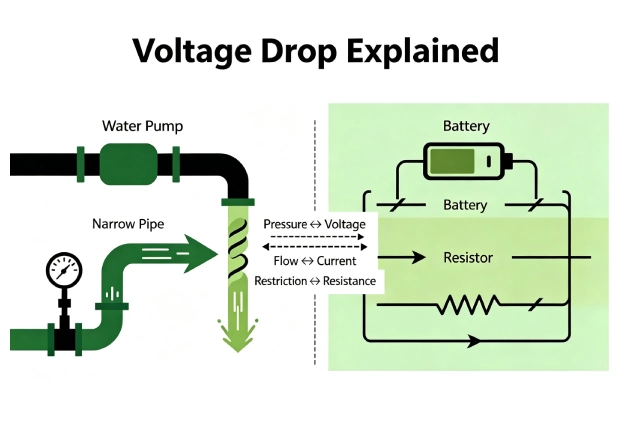
Simply put, a step-down transformer is a machine that steps electricity down from, say, 240 volts to, say, 12 volts, which is safer for electrical equipment.
Consider this: Your wall outlet is a fire hose at 100 PSI and a very good tool for a big job, but it is not the right pressure for a tool designed for a garden hose at 40 PSI.
The transformer acts as a connector in between. It takes the high pressure in, lowers it, and gives the reduced pressure to your tool. Under the hood, only a copper and iron device: less windings on the output and voltage drops. That’s it.
Core Components at a Glance
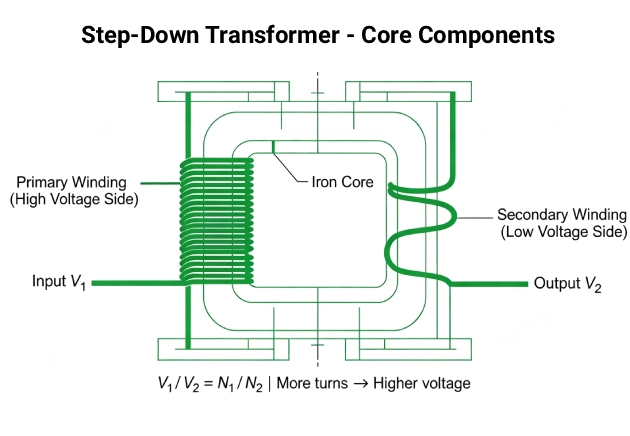
Primary Winding: High voltage in
Iron Core: Magnetic bridge
Secondary Winding: Lower voltage out
The three parts work all by themselves: the first winding is where the high voltage comes in, the iron core is the magnetic bridge that carries the power, and the second winding is through which the voltage drops. More windings in, fewer windings out.
Step-Up vs Step-Down: What’s the Actual Differences?
| Step-Down Transformer | Step-Up Transformer | |
| What It Does | High voltage in → Lower voltage out | Lower voltage in → Higher voltage out |
| Windings | More on primary, fewer on secondary | Fewer on primary, more on secondary |
| When You Need It | The incoming voltage is higher than what your load requires | The voltage you have is too low for the next part of your system |
| Application | Factory machines, office equipment | Long-distance power transmission, renewable energy systems |
The Complete 7 Types of Step-Down Transformers
Type 1: By Cooling Method — Dry-Type vs Oil-Immersed
Dry-Type Step-down Transformers:
Application: High-rise buildings, hospitals, underground subways, and data centers.
The Pros: Zero fire risk, no toxic fumes, and lower maintenance cost.
The Cons: Poor heat dissipation, and 20~40% higher in initial cost.
Oil-Immersed Step-down Transformers:
Application: Industrial parks, mining areas, and other extreme environmental conditions, such as high-temperature, high-altitude and heavy-polluted areas.
The Win: Excellent heat dissipation, easy to restore and repair, low noise, and high recyclability at end-of-life.
The Catch: Flammable, and detrimental to environment.
Type 2: By Number of Phases — Single-Phase vs Three-Phase
Single-Phase Step-down Transformers:
Application: Residential areas, small workshops, rural electrification, and office floors.
Advantages: Lower initial cost; easy to install, and widely available.
Disadvantages: Limited power capacity.
Three-Phase Step-down Transformers:
Application: Industrial parks, large factories, data centers, and commercial buildings with heavy loads.
Advantages: Higher power, higher power to weight ratio, and less vibration.
Disadvantages: Higher initial cost, and more complex installation.
| Pro Insight: Three-phase step-down transformer is made out of three single phases that come at slightly different times. This slight difference can be used to rotate motors with more power.
Type 3: By Mounting Type Pole — Mount vs Pad Mount vs DIN Rail Mount vs Portable Step-down Transformers
| Mounting Type | Advantages | Disadvantages | Best For | Typical kVA Range |
| Pole Mount | No land occupation. Installs on existing utility poles. No crane needed. | Limited to smaller capacities ( ≤ 167 kVA). Maintenance requires bucket trucks. | Rural farms, Australian ranches, US suburban overhead lines. | 10 ~ 167 kVA |
| Pad Mount | Tamper-proof enclosure. Safe for pedestrian areas. Handles large capacities. | Concrete pad and crane are needed to install. Higher upfront site prep cost. | Commercial plazas, housing estates, underground distribution. | 75 ~ 2500+ kVA |
| DIN Rail Mount | Saves cabinet space. Quick snap-on installation. Standardized worldwide. | Low capacity ( ≤ 5 kVA). Only Indoor use. | Control panels, medical devices, building automation. | 0.05 ~ 5 kVA |
| Portable | Mobility. No permanent installation. Easy plug and play for emergency use. | Higher cost per kVA. Not for long-term outdoor exposure. | Mining maintenance, construction temporary power. | 5 ~ 100 kVA |
Type 4: By Application — Power vs Distribution vs Control vs Isolation vs Traction Step-down Transformers
| Types | Typical Capacity | Pros | Cons | Application |
| Power Transformer | > 5,000 kVA | Highest efficiency, excellent over-load capacity, long service life | Heavy, large footprint, high initial cost, fire risk | Large motors, HVAC, or your entire plant |
| Distribution Transformer | 5 ~ 5,000 kVA | Widely available, smaller footprint, easier to replace or upgrade | Larger number of units, vulnerable to environmental damage, lower load capacity | Street lights, office buildings, or residential blocks |
| Control Transformer | 0.05 ~ 5 kVA | Compact size, low initial cost, many secondary taps for flexibility | High inrush current, poor heat dissipation especially for the sealed ones | PLCs, relays, machine tool controls, or CCTV |
| Isolation Transformer | 0.05 ~ 500 kVA | Protection of sensitive equipment, Common-mode noise rejection, lower fault levels | Efficiency loss, more expensive | Medical equipment, CNC machines, or lab instruments |
| Traction Transformer | 1,000 ~ 10,000 kVA | High short-circuit withstand capability, compact and lightweight, high overload capacity, excellent performance against severe vibration | High initial cost, higher maintenance cost, lower efficiency | Railways, metros, or traction motors |
Type 5: By Function — Complexity Pure Transformer vs Regulated Converter
If Stable Grid → Pure Transformer
Your voltage is within 5 percent of nominal. No wild swings here.
You just need a voltage change (say 220 V down to 110 V, or 11 kV down to 415 V).
Best for: Commercial buildings, industrial plants in developed grids, residential blocks.
If Unstable Grid → Regulated Converter
Your voltage is up and down, it’s 380 V one hour and 320 V the next (Brownouts and spikes will kill your CNC boards in 6 months).
Your sensitive equipment can t withstand 5 % swings (CNC machines, medical imaging, data centers).
Best for: Factories, mines, ships, off-grid remote locations in the developing world.
Type 6: By Winding Configuration — Two-winding vs Three-Winding vs Autotransformer
| Winding Type | How Many Voltages? | Electrically Isolated? | kVA Range | Application |
| Two-Winding | 1 in → 1 out | Yes | 100 MVA+ | Standard distribution, most industrial plants, residential buildings |
| Three-Winding | 1 in → 2 out | Yes | 100 MVA+ | Substations, large industrial complexes, wind farms |
| Autotransformer | 1 in → 1 out (close voltages) | No | Up to 500 MVA+ | Motor starting (reduced voltage), voltage matching between different grid standards, laboratories, equipment imported from different countries |
Type 7: By Core Material — CRGO Steel vs Amorphous Metal vs Ferrite
| Parameter | CRGO Steel | Amorphous Metal | Ferrite |
| Applicable Frequency | 50/60 Hz (Power Frequency) | 50/60 Hz (Power Frequency) | 10 kHz — 100 MHz (High Frequency) |
| Saturation Flux Density | ~2.03 T (Highest) | ~1.5 – 1.6 T | 0.2 – 0.5 T (Lowest) |
| Specific Core Loss (at 50Hz) | ~0.9 – 1.5 W/kg | ~0.2 – 0.4 W/kg (1/3 to 1/5 of CRGO) | Not applicable for power frequency |
| Permeability | 10,000 – 20,000 | 5,000 – 10,000 | 1,000 – 15,000 (at high frequency) |
| Initial Cost | Baseline (Low) | High | Low |
How to Choose the Right Step-Down Transformer?
Step 1: Get Your Input & Output Voltage & Capacity First
Input: What does your wall give you? (e.g., 480 V, 415 V, 220 V)
Output: What does your equipment require? (e.g., 400 V, 240 V, 110 V, 24 V)
Capacity: How much power do you need?
Step 2: Calculate the Required Power Rating (VA / kVA)
For single-phase: kVA = (V × A) / 1000
For three-phase: kVA = (V × A × 1.732) / 1000
| Pro Tip: Always add a 20 – 25 % safety margin for future expansion and startup surges (motors draw 5 – 7 x running current at startup).
Step 3: Match the Type to Your Physical Environment
| If Your Site Has… | Your Enemy Is… | Your First Choice |
| Rain | Moisture | Oil-Immersed (IP65 rated) |
| Limited floor space | Real estate | Pad Mount |
| Indoor / Occupied areas | Fire & Noise | Dry-Type |
| High ambient temperature | Overheating | Oil-Immersed |
| Mobile / Vibration | Physical stress | Traction or Portable |
Step 4: Price and Lead Time
Price:
Consider upfront cost, energy loss, maintenance, and downtime risk. Contact OMEK for pricing.
For instance, since you have a 100 kVA transformer, and it has a loss of 1 %, you are saving approximately 1,000 kWH per year, which you would be paying about $ 0.15 per kWH, so you would be saving $ 150 annually. The high efficiency unit is paid for in more than 10 years.
Lead Time:
Off-the-shelf (in stock): 1-3 days. Limited to popular sizes (e.g., 50 kVA, 100 kVA, 200 kVA).
Standard Production: Typically 4-6 weeks.
Full Custom (special voltage/frequency/enclosure): 8-12 weeks. Made-to-order. For projects that have unusual requirements.
Standard Single-Phase Wiring Diagram (H1-H4 / X1-X4)

Standard Three-Phase Wiring Diagram (Delta-Wye / Delta-Delta)

FAQs
Q: How to test a step-down transformer?
A: Smell it, check continuity, and test your output voltage. If it doesn’t pass any test then simply replace it. Not worth fixing.
Q: What is the approximate efficiency of a step-down transformer operating between 220V ac and 110V ac for the loads in a home appliance circuit (5 to 12 amps)?
A: About 95 – 97 % at full load (12 A) and much lower at a light load (5 A) and a lower cost unit can be even worse.
Q: Can I use a step-down transformer to step up?
A: Technically it works. But in practice, it s very risky, especially for long-term and heavy-load use. You may get some troubles like unstable, higher-than-expected output voltage, overheating, etc.

Posted by Victoria leave words
Thanks for reading! Hope you enjoy this article. If you have any questions about this blog, please leave a comment below, or contact OMEK's online customer service. Looking forward to having in-depth communication with you!
Leave a Reply