
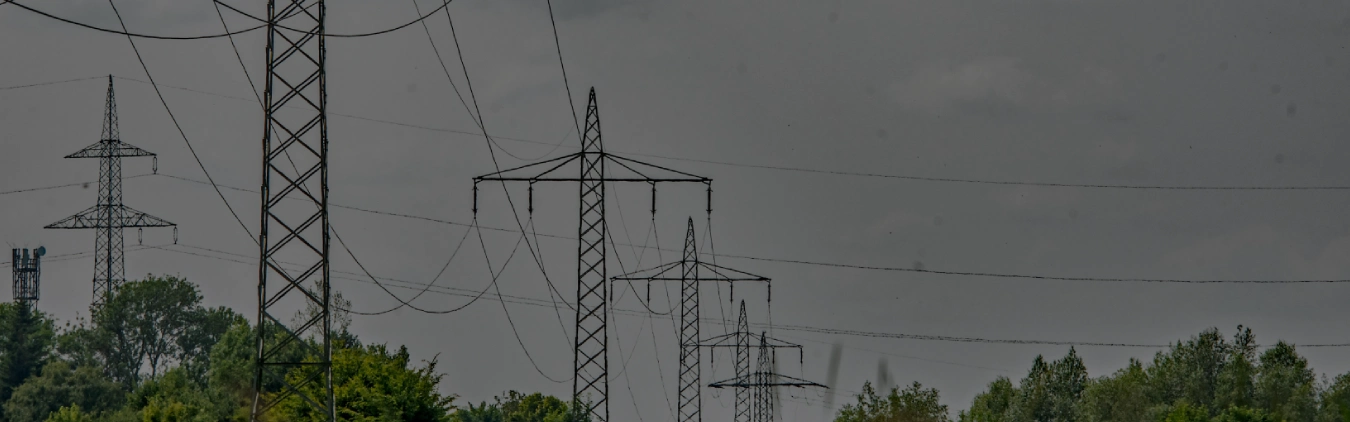
Every OMEK Power’s product goes through strict production process. We use advanced equipment and superior craftsmanship under rigorous quality standards. Our comprehensive quality control ensures that all the products are stable and designed for long-time service.
Production Workflow Overview
At OMEK, we only select the best raw materials during the procurement stage.
– Core Processing (Two options available for your choice: laminated type and wound type)
– Coil Winding
– Epoxy resin vacuum casting
– Assembly of active part
– Final assembly
– Assembly of active part
– Tank & structural component fabrication
– Active part drying & vacuum oil filling
– Final assembly & commissioning
Factory Testing
– Routine tests
– Type tests
– Special tests
How OMEK Transformers Are Made
Common Manufacturing Stages
Raw Material Procurement
OMEK strictly rejects inferior materials and selects only the best raw materials from leading industry suppliers. All materials we purchased, such as insulation materials, conductor materials, core steel, and transformer oil, must pass a full set of basic and extreme-condition tests. We will not cooperate with any supplier that provides low-quality materials.


Iron Core Processing (Laminated Type)
At this stage, we first cut silicon steel sheets into core laminations using precision longitudinal and transverse shearing machines. Then the core laminations are assembled into core columns and yokes using a step-lap stacking process.
After stacking, the core will be strapped and cured. Then annealed to remove processing stress, and inspected for stacking factor and excitation performance.
Core Processing (Wound Type)
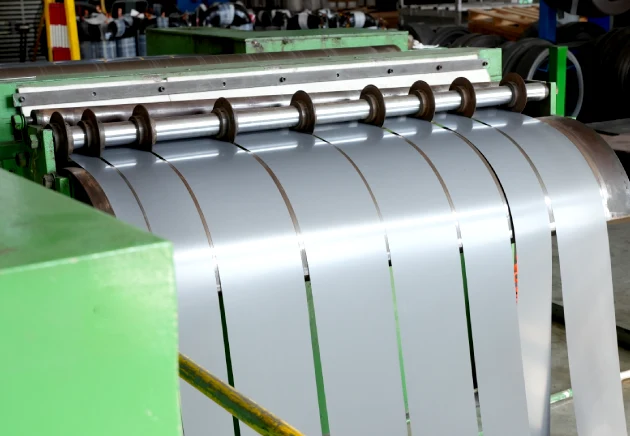
For wound type, first, we need to slit the silicon steel or amorphous alloy ribbons to the required width with a longitudinal slitting machine. Make sure that the burr height must be less than 0.02 mm to protect the insulation layer during winding.
Then, the steel strips should be fed into a CNC core-winding machine and continuously wound according to the designed diameter and number of layers. Thus we can get an integrated toroidal or rectangular cross-section core. After winding, the core will undergo seam treatment, annealing, curing, and insulation processing.

Coil Winding
OMEK is equipped with advanced CNC winding and layering machines. They are used to establish a fully automated production system. Programmed control ensures standardized and precise winding, effectively eliminating manual errors. A skilled technical team with over 10 years of transformer coil-manufacturing experience supervises the entire process.
Dry-Type Transformer Production

1. Epoxy Resin Vacuum Casting
In this step, the wound coils are placed into dedicated casting moulds and loaded into a vacuum casting tank to remove internal air.
Then, under controlled temperature and flow rate, the preheated epoxy resin mixture is injected into the mould.
After casting, the mould is transferred to a curing oven for step-by-step temperature curing for at least 24 hours, ensuring complete, void-free resin curing.
2. Assembly of Active Parts
Here the core and cast coils are assembled together with laser positioning to ensure concentricity accuracy.
Next, we should install the high- and low-voltage leads, tap changers, and insulation barriers. Then wrap and fix the lead connections, and inspect insulation clearances and active-part dimensions.

3. Final Assembly
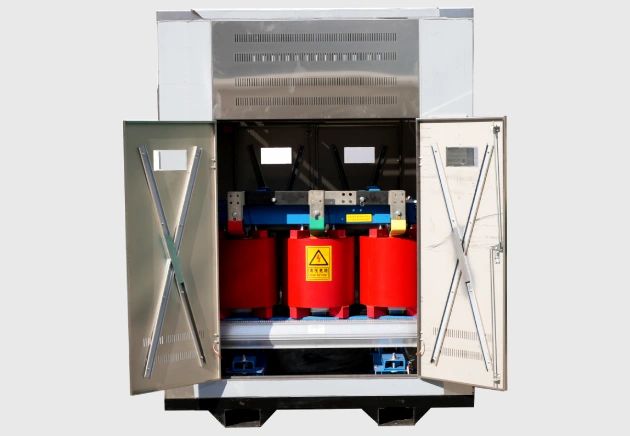
Here comes the final step of dry-type transformer assembly—installation of fans, temperature controllers, and enclosures. Power-on testing will be carried out on the fans and temperature controllers to ensure proper cooling and temperature monitoring.
Then we will ground the machine and do some refinement. Don’t forget to add nameplates and warning labels!
Oil-Immersed Transformer Production

1. Assembly of Active Parts
After the core and coils are assembled, insulation cylinders, angle rings, and compression blocks are installed to ensure vertical insulation distances meet design requirements.
And we need to connect HV and LV leads, install on-load/off-load tap changers and make the joints welded and insulated. Tests should be carried out on tap changer contact resistance and switching performance.
2. Tank & Structural Component Fabrication
Transformer tanks must pass penetrant testing (PT) and ultrasonic testing (UT) to detect weld defects, followed by air-pressure leak tests to verify sealing performance.
The tank surface will be acid-washed, phosphated, and coated. Then the radiators, conservators, Buchholz relays, and other accessories will be installed.


3. Active Parts Drying & Vacuum Oil Filling
In this part, we should place the assembled active parts into the vacuum drying oven to remove moisture from insulation materials.
The dried active parts will then be installed into the tank to be vacuum-evacuated. Processed transformer oil will slowly be injected using a vacuum oil-filling system. The injection speed is strictly controlled to avoid air gaps.
After filling, hot-oil circulation ensures thorough oil penetration into insulation gaps.
4. Final Assembly & Commissioning
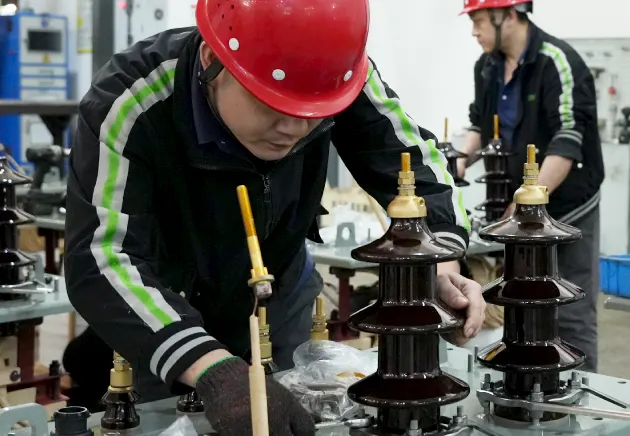
In this phase, we need to install bushings, thermometers, oil level indicators, and other accessories. Cooling systems (fans/oil pumps) will be connected and tested under power.
The tank will be coated for the last time and then sealed. The protective devices like the explosion-relief tubes and pressure-relief valves will be installed.
Factory Testing
Factory tests are mainly divided into three categories.
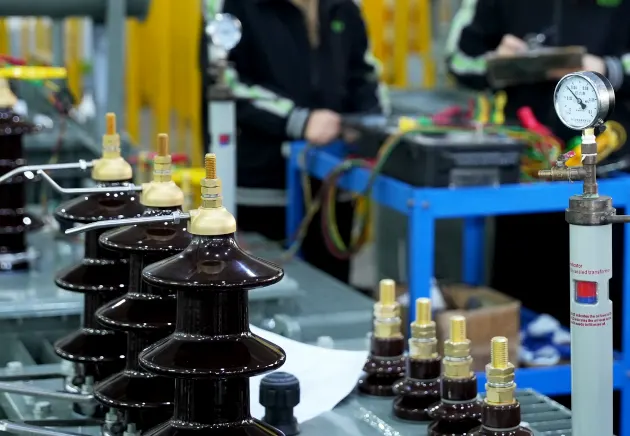
– Routine tests. They mainly include no-load test, load test, turns ratio test, and applied voltage test. Routine tests are mandatory basic tests conducted on each transformer.
– Type tests. Typical examples are short-circuit withstand test and lightning impulse test. Type tests are standardized tests conducted on specific models or batches.
– Special tests. For instance, the seismic performance test. Special tests are tailored tests carried out based on customer needs or special conditions.
After all tests are passed, the transformer is labelled, packaged, and shipped.
