
Hermetically Sealed vs Conservator Type Transformers: 7 Differences You Can’t Ignore?
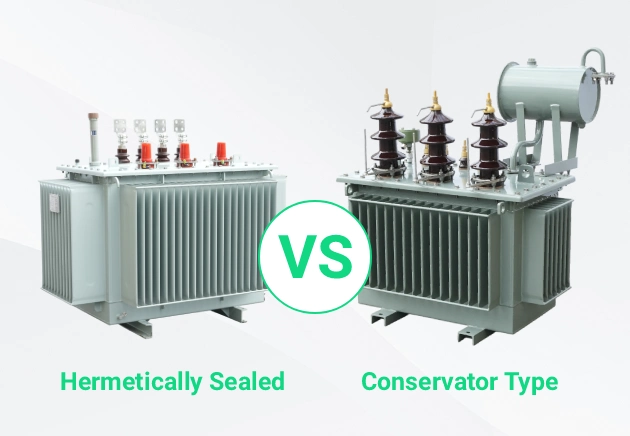
There’s a basic selection to make when selecting a transformer: conservator type transformer allows air to enter, while hermetically sealed transformer keeps it completely out. That single difference determines whether your transformer can last 20 years without maintenance, or costs you 30% more over its lifetime. In this guide, we break down 7 critical differences between hermetically sealed transformers and conservator type transformers, from voltage limits to overall cost of life, so you can pick the right one before your next purchase.
| About the Author: Victoria has more than 15 years of experience in manufacturing power transformers, having shipped 50,000+ units to 30 countries. The guide is based on actual field data and IEC 60076 standards.
An Introduction to Hermetically Sealed and Conservator Type Transformers
Hermetically Sealed Transformers
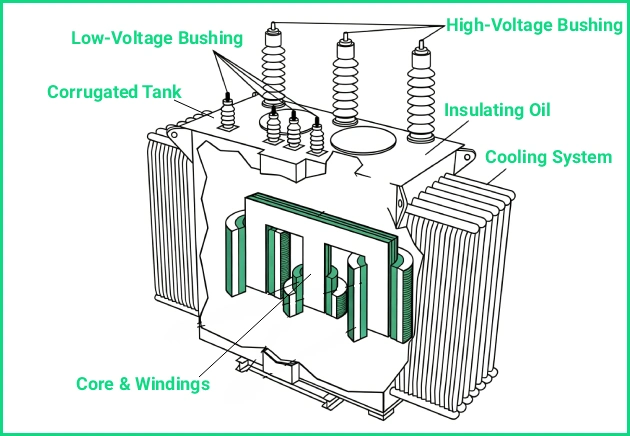
Hermetically Sealed Transformer Diagram
Definition&Working Principle
Hermetically sealed transformer is an oil-type power transformer with a fully sealed tank that completely keeps air out. This transformer seals the oil inside a corrugated tank equipped with an expansion radiator. The corrugated tank is self-compensating for oil volume changes as the temperature varies.
Core Components
· Corrugated Tank
· Insulating Oil
· Core & Windings
· Pressure Relief
· Cooling System
How Sealed Tank Transformers Manage Oil Expansion?— 2 Key Design Types
In a sealed tank transformer, there is no conservator tank to absorb oil expansion. Instead, the tank itself does the work—in one of two ways:
· Corrugated Tank Design: The walls of the tank are made in accordion-like folds. The oil, as it warms up and expands, will cause the folds to stretch out, thus expanding the volume of the oil in the tank. As the oil cools, the folds spring back. A mechanism of self-compensation maintains internal pressure in a safe range, without letting air in.
· Gas Cushion Design: A small volume of nitrogen gas is retained above the oil in the tank. The gas is compressed as the oil expands to take up the space. The gas expands back when the oil cools. The gas keeps the pressure positive to prevent moisture and air from entering the building.
| From our experience: Corrugated tanks are very durable in moderate climates. But in climates with significant temperature changes between day and night, desert climates for example, the constant swelling and shrinking can eventually damage welds over time. We normally recommend gas cushion models in such cases.
Benefits
· Lower Maintenance Cost: The sealed design protects inner parts from the air, moisture and contaminants, so there is no need to perform regular maintenance.
· Extended Oil Life: The oil is never exposed to oxygen or water, thereby keeping it from oxidizing or degrading. That makes it possible for the oil can to remain stable for 20-30 years.
· Environmental Protection: There is a complete seal and no oil leaks anywhere. This means that the equipment poses no threat to the environment.
Limitations
· Poor Heat Dissipation: Corrugated fins provides poor cooling capacity. They are sufficient only for small and medium capacity transformers, while extra external radiators are required for those with large capacity.
· No Bachholz Relay: Neither light gas alarm nor heavy gas trip is available.
· Limited Application Range: They can only be used in distribution transformers rated at 35 kV and 2500 kVA or below.
Conservator Type Transformers

Conservator Type Transformer Diagram
Definition&Working Principle
Conservator type transformer is a transformer with an additional oil tank on top, similar to the secondary fuel tank that collects fuel when the primary tank is full and returns fuel when the primary tank runs low. It can accommodate the expansion and contraction of insulating oil caused by temperature fluctuations.
Core Components
· Main Tank
· Insulating Oil
· Conservator/Oil pillow
· Silica Gel Breather
· Oil Level Gauge
· Bachholz Relay
Conservator Tank: Something You Need to Know

Conservator Tank Diagram
What Is a Conservator Tank?
A conservator tank is an auxiliary tank mounted on top of the main tank of an oil-filled transformer.
Working Principle & Function
The conservator tank allows for expansion space when the transformer oil is hot and channels it back when cool. In this manner, the transformer can “breathe” safely through a silica gel breather (like an air purifier for the transformer ) allowing the main tank to remain full and the oil dry.
Capacity & Sizing
· Baseline: 10% of Total Oil Volume
· Usable Working Volume: ≥ 7.5% of Total Oil Volume
· Normal Operating Oil Level: ~30% of Conservator Volume
Why It Matters?
If the transformer is the heart of your electrical system, the conservator is its lungs. That allows your system to breathe safely and protects it from contaminants. Weak lungs = weak heart.
Benefits
· Field Serviceable: Cover of main tank can be taken off to allow inspection, repair and maintenance of core and windings on site without sending the unit back to factory.
· Easy Oil Refilling: Standard equipment is available to fill the oil from the conservator’s filling plug.
· Visual Oil Level Monitoring: Oil level gauge with MAX/MIN marks provides operators visibility on the oil state and early detection of oil leaks.
· Lower Initial Cost: Flat-tank construction has much simpler manufacturing procedures than corrugated tank, so you don’t need high-precision hermetic welding.
Limitations
· Regular Maintenance Required: Periodic maintenance is needed, such as silica gel replacement, oil sampling, oil level checks, oil filtration or replacement.
· Oil Oxidation and Moisture Absorption: Oil is exposed directly to air in the conservator. Although a silica gel breather is provided, oxygen and moisture slowly get in, causing oil deterioration and decreasing the insulation’s life.
· Breather Maintenance Risk: Silica gel should be monitored and replaced if saturated. Otherwise, moisture can be taken up by the conservator which will cause the oil to deteriorate.
· Higher Cost of Ownership: The total cost of ownership is higher due to maintenance, oil testing, filtration and seal replacement.
Differences between a Sealed Transformer and a Non-Sealed Type Transformer
Specification Comparison Table
| Parameters | Sealed Transformers | Non-Sealed Type Transformers |
| Voltage Range | Typically ≤ 36 kV | Up to 220 kV and beyond |
| Power Range | Typically ≤ 3150 kVA | All sizes (from small to hundreds of MVA) |
| Sealing&Design Principle | Fully Sealed | Open to Atmosphere via Conservator |
| Oil & Insulation | Lifespan Extremely Long | Moderate |
| Typical Cooling Method | ONAN | ONAN / ONAF / OFAF |
| Protection & Fault Detection | Pressure Relief Devices | Buchholz Relay |
| Types of Oils | Mineral oil, natural ester, synthetic ester, silicone oil | Mineral oil (most common), synthetic ester (with special conservator) |
7 Core Differences: Deep Dive
1. Oil Expansion Management System
Hermetically Sealed: It has no external tank. Expansion is absorbed within the wall in an accordion-like fashion (corrugated walls) or by a nitrogen cushion. Oil never contacts air. No breathing, no breather.
Non-Sealed Type: It has an external conservator on top of the main tank. Oil expands when hot and flows back when cold, and it breathes through a breather. Oil contacts air. Expansion is done externally.
2. Air & Moisture Exposure
Corrugated Transformer: The oil is completely isolated from the atmosphere and moisture. No breathing and no contact lead to dramatically slower degradation of the oil in the transformer and aging of the insulation, thus a much longer service life.
Conservator Type: The oil breathes through a silica gel breather as temperature changes. The breather will retain some moisture, but not all, so eventually oxygen and moisture will begin to invade the oil, causing degradation to occur.
3. Cooling System
Hermetically Sealed: Cooling is almost always designed as ONAN (natural convection) against the corrugated tank walls, which also expand and dissipate heat. These walls work well for moderate ratings, but are limiting in expansion capacitance.
Non Hermetically Sealed: Cooling can be ONAN as well, but can also be ONAF (forced air) or OFAF (forced oil) since external radiators, fans, and oil pumps can be used to accommodate even larger loads. This design can handle any size, from small units to large-scale power stations.
4. Protection & Fault Detection
Hermetically Sealed: There are no pipes connected to the Bucholz relays, so they cannot be used in fully sealed relays. Protection is based on a Pressure Relief Device (PRD) and a number of passive sensors. It works well especially in overpressure conditions, but not if the system has been internally over heated slowly or if there is any partial discharge fault.
Conservator Type: The Bucholz relay is its standard equipment. It is attached to the conservator pipe and is used to alarm for anything that is slowly accumulating in the gas and trip on anything that is suddenly building up in the oil. The relays continue to function for both faults.
5. Maintenance Requirements
Hermetically Sealed: Regular maintenance is not required. You don’t need to change silica gel, take oil samples or check breathers, saving your time and ongoing costs.
Oil-Immersed Conservator Type: Regular maintenance never stops. Silica gel should be replaced every 3~6 months, oil samples taken once a year or every other year, and seals to be checked.
6. Equipment Height and Footprint
Hermetically Sealed: Its compact and low-profile design with no external conservator tank on top is ideal for indoor substations, underground vaults, and ceiling-height-limited sites.
Conservator Type: Taller design—the extra tank on top adds significant height. This means you’ll need higher ceilings, more outdoor space, and often a crane for installation.
7. Environmental Resilience
Hermetically Sealed: This kind of transformer is ideal for harsh environments. Its fully welded and sealed breather-less system completely prevents moisture, saline, dust, and other contaminants, unlike other transformers that are prone to malfunction in such conditions.
Conservator Type: A breather system facilitates the circulation and exchange of air with the external atmosphere, making it vulnerable to harsh environment.
| Case in point: A client in the Philippines installed a sealed tank transformer in a coastal substation. Oil quality was found to be very close to “new” after 8 years of operation. Their previous conservator unit installed in the same environment however, was in need of silica gel replacement every 4 months as moisture and salt infiltration into the unit occurred.
Selection Guide: Which Transformer Fits Your Site?
When to Choose Hermetically Sealed Transformers:
· Installed in indoor or urban settings
· Installed in harsh or humid settings (eg. coastal, underground etc.)
· Installed in locations with difficult maintenance access
· Lifecycle maintenance cost is a major concern
· Substations are height-restricted
When to Choose Conservator Type Transformers:
· Large scale, outdoor installations
· High voltage (>36 kV) applications
· Maintenance is more accessible
· Initial cost is more a concern
Summary
It’s simple! If you want a solution that lasts 20+ years with little to no maintenance, Hermetically Sealed Oil Transformer is your best option, especially if you are working with an indoor or high humidity application. Hermetically Sealed Oil Transformer will save you thousands of dollars in maintenance costs.
If your application involves high voltages of > 36 kV and you have the infrastructure to accommodate yearly maintenance, the Conservator Type is your best option. Keep in mind that the Non-Sealed Transformer is significantly less expensive but will cost you more over the course of its lifetime. Up to 30% of the total Conservator Type costs over the 20-year period are expected to be caused by the frequent replacement of silica gel, yearly sampling of the oil, and replacement of the seals.
Not sure yet which fits the project the best? Please reach out to OMEK for custom solutions to your site conditions, voltage needs, and finances.
OMEK’s hermetically sealed and conservator type transformers are manufactured for voltages up to 220 kV and power ratings up to 100 MVA. IEC 60076, IEEE C57, and ANSI standards are incorporated in all manufacturing processes to ensure compliance. OMEK has established lasting business relationships with utility companies, industrial plants, and EPC contractors over the past 15 years with 50,000+ units in more than 30 countries, in the Southeast Asia, Middle East, Africa & South America.
Frequently Asked Questions (FAQs)
Q: Can I take oil samples from a sealed transformer?
A: Not routinely. Oil should not normally be sampled. This transformer is meant to be maintenance free and popping open the sampling valve unneeded can cause the seal to be broken or allow air to get in.
Q: What is the oil filling procedure for a corrugated transformer?
A: Under vacuum filling. Vacuum the tank to dry the insulation (vacuum for at least 4 hours).
Q: Non-sealed Type: What Pathways Allow Moisture to Enter a Transformer, and What Degrades Transformer Insulation?
A: Moisture poses a constant threat to the integrity of a transformer’s insulation. It gains entry through the breather, aged seals, or valves that are left open.It is detrimental after being introduced, as it decreases the dielectric strength and hastens paper ageing. Sealed designs do away with the pathways altogether, and the transformer remains healthy for 20+ years with a dry oil.
Q: What does the “minimum” oil level mean on a conservator tank?
A: The minimum oil level is the lowest safe oil level that the conservator should reach under the coldest operating conditions. It corresponds to an oil temperature of -5°C.
Confused about which option to go with for your specific project? Let’s work out an exclusive recommendation together with OMEK. Contact us!

Posted by Victoria leave words
Thanks for reading! Hope you enjoy this article. If you have any questions about this blog, please leave a comment below, or contact OMEK's online customer service. Looking forward to having in-depth communication with you!
Leave a Reply