
Dry Type Transformer Types: Complete Guide to Cast Resin, VPI & More
Dry type transformers are one type of transformers, yet many people are not fully familiar with them. Today, OMEK Power, experienced in the transformer industry for nearly 20 years, will comprehensively introduce the various types of dry type transformers from multiple perspectives.

This complete guide to dry type transformer types will give you a clear and insightful understanding.
What Is A Dry Type Transformer?
A dry-type transformer refers to a transformer whose windings and core are not immersed in insulating oil, but instead rely on solid materials such as epoxy resin for insulation. This is the core difference compared to the oil type transformer.
It mainly consists of an iron core and coils. Insulating cylinders are placed between the high-voltage and low-voltage coils, to enhance electrical insulation, while coil spacers provide support and restraint for the coils.
Dry-type transformers rely on air convection for cooling. The cooling methods are categorized as natural air cooling (AN) and forced air cooling (AF). With natural air cooling, the transformer can operate continuously at rated capacity over long periods. With forced air cooling, the output capacity of the transformer can be increased by 50%.
Dry-type transformers are highly suitable for indoor enclosed spaces, densely populated areas, and locations with special requirements for fire protection and explosion prevention, such as high-rise buildings, data centers, subways, etc.
Dry Type Transformer Types
By Phase
Due to the diversity of power supply systems and loads, dry type transformers are classified by phase number into single-phase transformers and three-phase dry type transformers (dry type triplex transformers).
| Type | Features & Applications |
|---|---|
| Single-phase dry type transformer | Typically has a smaller capacity. It is commonly used in low-power applications, such as residential lighting and small household appliances. It features a single-phase input and output. Suitable for single-phase loads. |
| Three-phase dry type transformer | Designed for use in factories, large equipment, commercial power systems, and other three-phase electrical applications. It has three-phase input and output, providing a more stable power supply. |
By Cooling Method
| Type | Features & Applications |
|---|---|
| Natural cooling transformer (AN) | It relies on air convection for natural cooling. It is suitable for applications with light loads and low ambient temperatures. |
| Forced cooling transformer (AF) | It accelerates cooling through equipment such as fans or pumps. It is suitable for applications with heavy loads and high ambient temperatures. |
By Core Structure Material

| Type | Features & Applications |
|---|---|
| Silicon steel laminated transformer | This is the most common core structure in the market. The core is composed of thin silicon steel sheets, which are stacked horizontally and pieced together. Making the silicon steel into thin, insulated sheets and stacking them can interrupt the large-area eddy current circuits, thereby reducing iron loss. |
| Silicon steel rolled core transformer | A whole silicon steel strip is wound into a coil to form the core. Compared with the traditional laminated core, its core has no obvious seams, and the magnetic path is more continuous. The no-load current is smaller, and the no-load loss is lower. It operates more quietly. |
| Amorphous alloy core transformer | The core is made of amorphous alloy material. Amorphous alloy is a highly technological material. It is formed by cooling molten iron, boron, silicon, etc. into a metal alloy at a speed of one million degrees per second, resulting in an unordered atomic structure. Within 0.001 seconds, the 1300℃ alloy liquid is turned into a strip. It has excellent electromagnetic properties! It is currently the transformer with the lowest loss and the most cost-effective! |
By Voltage Level
| Type | Features & Applications |
|---|---|
| Low-voltage dry transformer | Usually used for residential and general industrial electricity. With lower voltage levels, such as 0.22KV, 0.38KV, 0.66KV |
| Medium-voltage dry transformer | Used for urban power grids and industrial and mining enterprises. With moderate voltage levels, such as 6KV, 10KV, 20KV, 35KV, 66KV |
Why are high voltages (such as 110KV, 500KV, etc.) rarely used for a dry type transformer?
Because the higher the voltage, the greater the insulation requirements are. Dry type transformers will be too large in volume and occupy too much space. Additionally, in high-voltage environments, dry-type transformers generate severe heat and are not as good at dissipating heat as oil-immersed transformers. Therefore, for long-distance power transmission in power grids and large substations, oil-immersed transformers are the most suitable.
By Rated Capacity
The rated capacities of different specifications of dry-type transformers also vary. The rated capacity of the transformer is calculated based on the R10 priority factor. These rated capacities 50kVA, 80KVA, 100kVA, 125kVA, 160kVA, 200kVA, 250kVA, 315kVA, 400kVA, 500kVA, 630kVA, 800kVA, 1000kVA, 1250kVA, 2000kVA, 2500kVA, 3150kVA are widely recognized as standard capacities in the transformer industry. If you’re unsure which transformer capacity best fits your needs, read our guide on How to Choose the Right kVA Size for Your Needs.
Here is OMEK Power’s three phase dry type distribution transformers (energy efficiency grade 1) specifications and size data Download Datasheet

By Heat Resistance Grade (Insulation Grade)
The maximum temperature that a dry-type transformer can withstand is entirely determined by the insulating material. The main insulation materials are classified into multiple grades such as A, E, B, F, H, and C, and the main differences in their heat resistance levels are as follows:
| Insulation Class | Temperature Standard |
|---|---|
| A-class | The maximum allowable operating temperature is 105°C, and the maximum temperature rise should be less than 60K. |
| E-class | The maximum allowable operating temperature is 120°C, and the maximum temperature rise should be less than 75K. |
| B-class | The maximum allowable operating temperature is 130°C, and the maximum temperature rise should be less than 80K. |
| F-class | The maximum allowable operating temperature is 155°C, and the maximum temperature rise should be less than 100K. |
| H-class | The maximum allowable operating temperature is 180°C, and the maximum temperature rise should be less than 125K. |
| C-class | The maximum allowable operating temperature is 220°C, and the maximum temperature rise should be less than 150K. |
Since the coil insulation of dry-type transformers usually uses F-class and H-class insulation materials, the absolute maximum temperature of the transformer is not allowed to exceed 155°C and 180°C respectively. If the winding temperature of the dry-type transformer is too high, it will cause the insulation to age more rapidly, which in turn will affect the service life or lead to short circuits, fires and other faults.
Therefore, from the perspective of the hot spot temperature alone, the operating temperature of the transformer should be as low as possible. To prevent abnormal operating temperatures, strict inspections or monitoring should be carried out during use.
By Use/Purpose
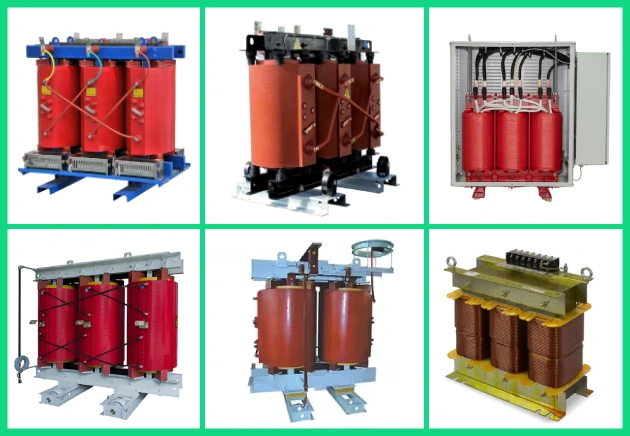
| Type | Features & Applications |
|---|---|
| Dry-type distribution transformers (Distribution) | Voltage: The voltage on the high-voltage side is usually up to 10KV, with the maximum being 35KV; the voltage on the low-voltage side is often 0.4KV. They can supply 3-phase 400V power for industrial heavy equipment, and single-phase 230V power for daily lighting and household appliances. Capacity: Commonly from 30KVA to 2500KVA. Widest application: Distribution transformers account for over 80-90% of the dry-type transformer market. |
| Dry-type power transformers | Used in large industrial equipment and power plants, etc. They can withstand large currents and high power loads, ensuring the stability and reliability of power supply. |
| Isolation Dry Type Transformer | The high-voltage winding and low-voltage winding are independently wound, with insulating materials placed in between and leaving gaps. There are no direct connections of wires. Electrical energy is not transmitted directly through wires, but is transmitted through magnetic fields in a non-contact manner. The two circuits are independent of each other. If one circuit leaks electricity or malfunctions, it will not affect the other side. Suitable for medical, precision equipment, and anti-interference applications. |
| Rectifier Dry Type Transformer | Specifically designed to be paired with a rectifier, and convert alternating current to direct current. It is mainly used for welding machines, charging stations, and electrolytic equipment. |
| Excitation Dry Type Transformer | It reduces the grid voltage to an appropriate level, stabilizes the supply to the excitation coils of the generator, enabling it to generate a magnetic field and allowing the generator to start and generate electricity smoothly. Generally, large-power, grid-connected, industrial large-scale generators require excitation dry-type transformers. |
| Autotransformer (Self-coupled Dry-type Transformer) | The high-voltage and low-voltage circuits share the same set of coils. A portion of the coils serves as both the high-voltage and low-voltage components. By cutting different turns of the coil, different voltages can be obtained, achieving both voltage boosting and reduction. It is commonly used in factories and construction sites where the voltage is unstable. |
By Energy Efficiency Level
Dry-type transformers are usually classified into 1st, 2nd, and 3rd grades. Among them, the 3rd grade is generally the energy efficiency limit value, while the 1st grade has the highest energy efficiency and the lowest loss.
If you are more concerned about long-term operating electricity costs, you usually prioritize the 1st energy efficiency grade; if you are more focused on the initial investment, you may also consider the 2nd grade.
The 3rd grade is usually just the minimum compliance line and is not suitable as the preferred choice for efficient energy-saving projects.
By Structure
Cast resin dry type transformer and vacuum pressure impregnation type (VPI/air-insulated impregnation)
| Type | Features & Applications |
|---|---|
| Cast resin dry type transformer (aka cast coil dry type transformer) | Epoxy resin is a non-flammable, flame-retardant, self-extinguishing solid insulating material, which is both safe and clean. Therefore, the dry type transformer impregnated with epoxy resin has the characteristics of no oil, non-flammability, low operating loss, and outstanding disaster resistance, and is widely used. Compared with oil-type transformers, the dry-type transformer has no oil, so there are no problems such as fire, explosion, and pollution. The loss and noise have been reduced to a new level, creating conditions for placing the transformer and the low-voltage panel in the same power distribution room. So to say, it is the best dry-type padmount transformers for indoor use. |
| Vacuum pressure impregnation type (VPI type) | The coil is not placed in the mold but directly put into the vacuum tank. Through vacuuming, the resin is injected, and pressure is applied to press the resin into the inter-turn and inter-layer gaps, and then it is cured. From the outside view, the coil can still see the copper wire / insulating paper, and the surface is a thin and uniform layer of resin. This kind is a ventilated dry type transformer. |
Various special-purpose dry type transformers:
Dry type transformers are applicable to various fields and various special purposes, such as special transformers for nuclear power plants, marine and offshore platforms, and steel rolling, etc. For such dry type transformers, as long as the relevant technical requirements are provided, OMEK Power can develop the design and produce them.
OMEK Power – IEC 60076 Certified Dry-type Transformer Manufacturer
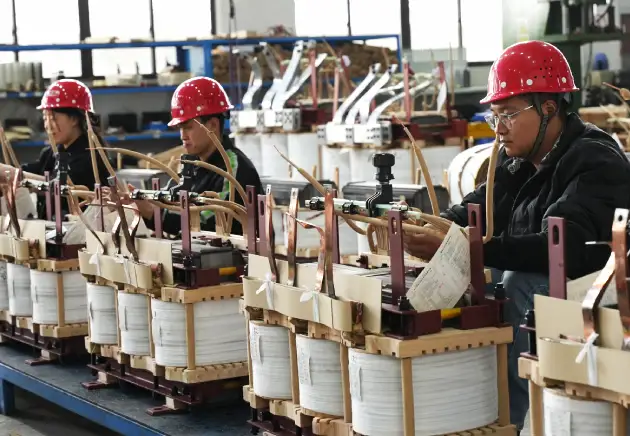
We are a China manufacturer, delivering reliable dry type and oil immersed transformer solutions to power projects worldwide. We can customize production according to your requirements. Such as, specific requirement on the rated capacity, no-load indicators, connection group, impedance voltage, whether you need a shell or not, etc., all can be quoted for you.
✅ Amorphous transformer
✅ Copper transformer
✅ Cast resin dry type transformer
✅ VPI dry type transformer
✅ Dry type substation transformer

Posted by Victoria leave words
Thanks for reading! Hope you enjoy this article. If you have any questions about this blog, please leave a comment below, or contact OMEK's online customer service. Looking forward to having in-depth communication with you!
Leave a Reply