
Why Are Transformers Rated in kVA — And How to Choose the Right kVA Size for Your Needs
Transformers are essential in modern power system. When talk about transformers, we inevitably refer to the term kVA. For a layman, kVA is not very familiar. In our daily life, we often use “W” or “kW” to describe the power of electrical appliances. So here comes the question: Why are transformers rated in kVA, not in kW? The answer lies in understanding how transformers work and what their rating means. After reading this blog, you will be able to understand how to choose a proper transformer capacity for your electrical system.
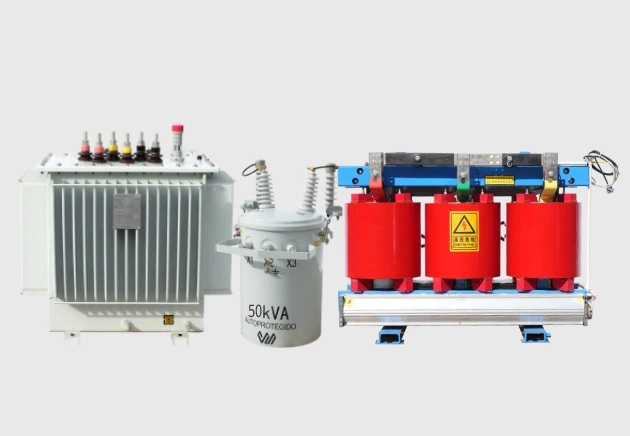
transformers rated in kva
What is transformer?
In plain language, a transformer is an electrical device that changes voltage levels of alternating current (AC). Its main duty is to step up or step down voltage to satisfy people’s needs. It only works with AC, doesn’t work with direct current (DC). The working principle of transformers is electromagnetic induction. They play an important role in efficient power transmission, reducing energy loss and maintaining stable power supply. You can find them wherever electricity is needed.
What is kVA in transformer
kVA means kilovolt-ampere, it’s a unit of apparent power.
In the electrical system, there are 3 kinds of power:
Real Power (kW):
Actual power which does the work – running lights, heating, or motors.
Reactive Power (kVAR):
The power needed to keep magnetic and electric fields going in things like motors, transformers, and fluorescent lights.
Apparent Power (kVA):
Real and Reactive Power combined.
They are related by the following formula:
kVA(2)=kW(2)+kVAR(2)
or more practically:
kVA= kW/Power Factor
So if a machine is using 80 kW at a power factor of 0.8 then its apparent power would be 100 kVA.
This is in kVA, which is how much load the transformer has to deal with, both real and reactive.
Why transformers rated in kVA instead of kW?
Transformers aren’t like generators or motors. They don’t make or use power. Instead, they take power from one voltage level and change it to another. Transformers are made according to the required voltage and current that is generally written in kVA on the nameplate. We call this “transformer rating”.
There are two kinds of transformer power: rated power and working power. The rated power of a transformer means its designed largest ability, but its working power relies on the real burden when it works. Temperature changes have an effect on how much power a transformer uses, but the temperature itself is changed by the transformer’s losses.
There are two kinds of losses.
1. Core (Iron) Losses
Core (Iron) Losses depend on voltage. These losses occur due to magnetization of the core and are proportional to the supply voltage.
2. Copper (Winding) Losses
Copper (Winding) Losses depends on Current. These losses come from the resistance in the windings, and they go up when there’s more current.
Neither voltage nor current depends on the power factor of the load. Therefore, transformer manufacturers specify ratings in apparent power (kVA), which accounts for both.
If transformers were rated in kW, it would be different with the power factor of the load – inconsistent and not practical. But when we use kVA, then every type of load will have a standard rating.
How to calculate and select the right transformer size
To find out which transformer size is right for you, you have to know your power needs and how things work. Transformer size is generally determined by the total load it will provide, measured in kVA (kilovolt-amperes).
1. Calculate the total load:
Add up the power ratings of all equipment connected to the transformer. If the total load is given in kW, convert it to kVA with this formula:
kVA = kW / Power Factor (PF)
For example, if we have a transformer with 80 kW load and a power factor of 0.8, kVA = 80 / 0.8 = 100 kVA.
2. Consider future expansion:
Include a margin of around 20-25% so that there is room for extra equipment or more growth in the future. It will make sure that your transformer will not be overworked as the demand grows.
3. Check voltage requirements:
Transformer’s main voltage should be in accordance with the power supply voltage and the secondary voltage should correspond to the load need.
4. Evaluate load type:
Load different like motors, lights, electronics all have different starting current and voltages. Pick out the transformer that can deal with these changes well.
5. Environmental conditions:
Think about factors such as surrounding temperature, the altitude, whether it is indoors or outdoors. Those things will all affect its performance and cooling ability.
If you calculate your load, voltage, and what you will need in the future then you can choose the right transformer size to make sure your electrical system is safe, efficient, and reliable for a long time.
Common mistakes when choosing transformer size.
1. Ignoring Power Factor
Sizing solely on kW without factoring in the power factor results in under-rated transformers.
2. No room for future load growth
If we have some oversights, then there would be early overloads when the demand starts to go up.
3. Confusing kVA with kW
KVA is total capacity, kW is the useful power. You always size by kVA.
4. Using the Wrong Voltage
Confirm the primary and secondary voltages with your utility company.
5. Neglecting Inrush Current
Motos, compressors and welders all have very large start up currents which is above the normal rating.
6. Over-Sizing Without Need
Bigger transformers look safer, but they could run poorly with just some of the power used, wasting it.
Why Proper Transformer Sizing is Important
Choosing the correct kVA transformer effects all of your power system.
Efficiency: The right size cuts down on copper and core loss.
Reliability: it avoids overheating and voltage drops during the peak load.
Safety: Correct size cuts down on danger from insulation failure and fires.
Cost savings: right sized transformer lowers electric bill and maintenance cost.
Longevity: balanced loading increases transformer life.
Renewable energy, manufacturing, data centers, etc., in these kinds of industries, we need to size the transformer accurately so that it can run continuously.
Real World Tip from OMEK Engineers
At OMEC Transformers, we usually tell our customers to think about more than just how much it can hold, but also what kind of things it will be doing and how they will use it.
Like if you had a 250 kVA transformer running at full load 24/7 in the tropics, it might need more cooling or a better efficiency class than one that’s used occasionally in a cooler place.
We offer our own tailor-made transformer sizing service – we will analyze your load data, voltage stability and harmonics before giving you a recommendation on what is the right design for you.
Types of transformers based on application.
Transformer categories help us understand better, so we can pick the right one.
| Type | Description | Typical kVA Range |
| <strong”>Distribution Transformer | Used to step down voltage in the network | 25–2500 kVA |
| Power Transformer | Used in transmission or large industrial facilities | 1000 kVA and above |
| Dry-Type Transformer | Air-cooled, ideal for indoor or fire-prone environments | Up to 5000 kVA |
| Oil-Immersed Transformer | Oil-cooled, suitable for outdoor or heavy-duty use | 25–100,000 kVA |
| Pad-Mounted Transformer | Enclosed unit for urban distribution | 75–3000 kVA |
| Pole-mounted transformer | Designed to be installed on utility poles | 5-500 kVA |
Why OMEK Transformers?
OMEK Transformers has more than 40 years of experience in designing and manufacturing dependable power and distribution transformers for customers in over 40 countries.
We offer:
Custom built designs ranging from 10 kVA to 2500 KVA
Dry type, oil immersed, and cast resin transformer options
Proven Performance in Utilities, Infrastructure, Renewables & Industrials
Strict quality control and factory testing according to international standards (IEC,IEEE,ANSI).
We want to help you pick out a transformer that gives steady power, good efficiency, and lasting dependability – at just the right kVA size for what you’re doing.
Whether it is a dry type, an oil immersed one or a customized one, OMEK engineers can help you find out what is the best kVA rating for your particular application.
Contact us today to have a free consultation so you can get the right transformer that is reliable, efficient, and saves money in the long run.

Frequently Asked Questions
1.What is kVA on a transformer?
kVA is kilovolt-amperes, it is a unit to measure the apparent power of a transformer. It contains both real power(kW) and reactive power(kVAR) which represents the entire electrical load a transformer can take.
2. How do I change kW to kVA for the transformer size?
Use this simple formula:
kVA = kW ÷ Power Factor (PF)
For example, if the load is 80 kW and the power factor is 0.8, then kVA = 80 / 0.8 = 100 kVA.
3.Why are transformers rated in kVA, not in kW?
Transformers are rated in kVA as their loss depends on the voltage and current, not the power factor of the load. Use kVA to make sure you get a steady rating no matter what kind of load it is.
4.How much extra capacity do I need when choosing a transformer?
Add around 20-25% more capacity for the future load increase or if you want to expand. To prevent overloading and prolong the life of the transformer.
5.What will happen if I pick a transformer that is too tiny?
An undersized transformer will get too hot, cause voltage drops and fail early. Calculate the total load always and add some safety.
6.Can I use more than I need? A bigger transformer?
Yes, but if you over-size it by too much, then the efficiency goes down and you get more energy loss at part load. Pick a size close to what you actually and expect to use.
7.Power Transformer VS <strong”>Distribution Transformer?
Power transformer is used in high voltage transmission network and distribution transformer is used to give electricity at low voltage to the local or industry.
8. How do I know which transformer is best for me?
You can contact OMEK Power for professional assistance. Our expert team will analyze your load profile, voltage conditions and environment and then recommend the proper transformer type and size for you.

Posted by Victoria leave words
Thanks for reading! Hope you enjoy this article. If you have any questions about this blog, please leave a comment below, or contact OMEK's online customer service. Looking forward to having in-depth communication with you!
Leave a Reply