
Substation vs Transformer: What’s the Difference?
Substation
What is a substation?
A substation is a place where voltage is changed. In order to transmit the electricity generated by power plants to distant places, the voltage must be raised to a high voltage, becoming high voltage electricity, and then reduced as needed near the users. This work of raising and lowering the voltage is accomplished by substations.
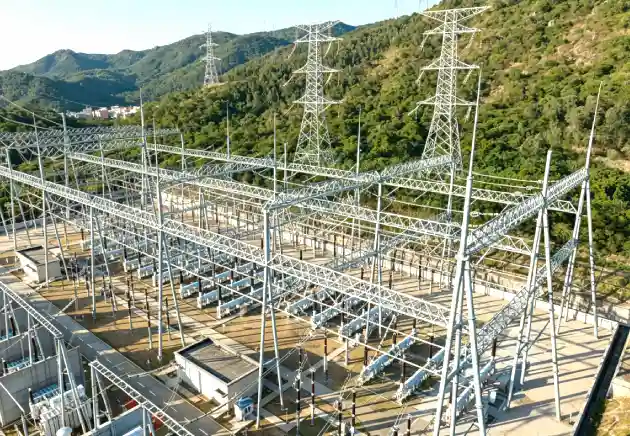
A substation is usually located at the end of the transmission line. The main equipment in a substation is switches and substation transformers. Including step-up and step-down substations of various voltage levels.
What is the function of a substation?
A substation is an electrical facility in the power system that transforms voltage, receives and distributes electric energy, controls the flow of electricity, and adjusts voltage levels. It connects power grids at different voltage levels through its transformers.
In specific applications, substations perform AC-DC-AC conversion processes. Such as in undersea transmission cables or long-distance power transmission. Some systems use high-voltage direct current (HVDC) transmission. It overcomes capacitive reactance losses associated with alternating current (AC) transmission. It offers energy-saving benefits.
Substations primarily step down from high voltage to medium voltage, or convert high voltage to a lower level of high voltage. They occupy relatively large areas. Area sizes vary per different voltage levels and capacities. This is why they are commonly referred to as substations.
A substation serves as an intermediate link between power plants and end users. Since power plants are often located far from cities and industrial facilities, and since the voltage generated at power plants is relatively low, the resulting current becomes very high.
According to Joule’s law, high current generates significant heat along transmission lines, which can damage the lines and represents energy loss in the form of heat. Therefore, it is necessary to increase the voltage from the power plant via substations to as high as 500,000 volts for long-distance transmission to urban areas and factories. Upon arrival, local substations then reduce this voltage and distribute it through various means to the standard 220 volts used in everyday household and industrial applications.
The location of the substation
From the perspective of power supply economy, substations and distribution stations should be close to the load center.
From a production perspective, the substation and distribution station should not impede production or transportation within the plant. The transportation of the substation’s own equipment should also be convenient.
From a safety perspective, substations and distribution stations should avoid flammable and explosive areas.
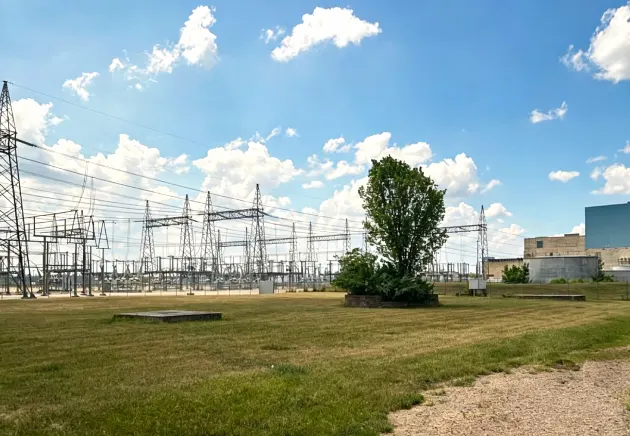
The substation and distribution station should be located on the upwind side of the unit. In enterprises, it is not advisable to set up in places where dust and fibers are prone to accumulate. Substations and distribution stations should not be located in densely populated areas. The site selection and construction of substations and distribution stations should also take into account the requirements of fire extinguishing, corrosion prevention, pollution prevention, water prevention, rain prevention, snow prevention, earthquake prevention and prevention of small animals from entering.
Transformer
What is a transformer?
A transformer is a static electrical device used to transform alternating voltage and current and transmit alternating electrical energy. It realizes the transmission of electrical energy based on the principle of electromagnetic induction.
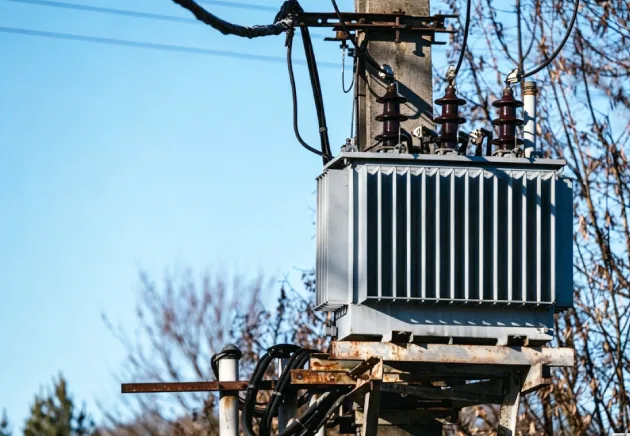
Transformers can be classified into power transformers, distribution transformers, test transformers, instrument transformers and special-purpose transformers according to their uses.
Power transformers are essential equipment for power transmission and distribution as well as for power users’ distribution.
A test transformer is a device used to conduct withstand voltage (boost voltage) tests on electrical equipment.
Instrument transformers are used for electrical measurement and relay protection in power distribution systems (PT, CT).
Special-purpose transformers include electric furnace transformers for smelting, electric welding transformers, rectifier transformers for electrolysis, and small voltage regulating transformers, etc.
Principle of Transformer
A transformer is a device that transforms alternating voltage, current and impedance. When alternating current flows through the primary coil, alternating magnetic flux is generated in the iron core (or magnetic core), inducing voltage (or current) in the secondary coil.
A transformer is composed of an iron core (or magnetic core) and coils. The coils have two or more windings, among which the winding connected to the power supply is called the primary winding, and the rest are called secondary windings. In a generator, whether the coil moves through a magnetic field or the magnetic field moves through a fixed coil, an electromotive force can be induced in the coil.
In both cases, the value of the magnetic flux remains unchanged, but the number of magnetic fluxes intersecting with the coil varies. This is the principle of mutual induction. A transformer is a device that uses electromagnetic mutual induction to transform voltage, current and impedance.

Posted by Victoria leave words
Thanks for reading! Hope you enjoy this article. If you have any questions about this blog, please leave a comment below, or contact OMEK's online customer service. Looking forward to having in-depth communication with you!
Leave a Reply