
Rectifier vs Transformer: What’s the Difference and How Do They Work?
You must first understand the concept of each before you can distinguish them.
1. Transformer
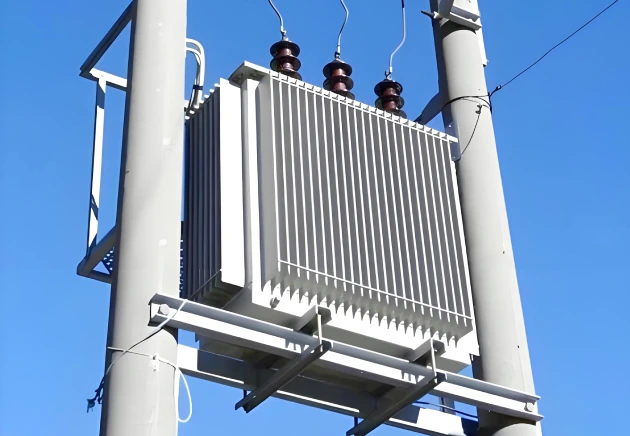
Transformer, in a narrow sense is, through electromagnetic coupling, to convert alternating current energy of one specification into another specification, such as the transformation of voltage and current. However, no matter how it is converted, energy is conserved. In a broad concept: Any device capable of transforming voltage can be called a transformer. For example, switching power supplies, resistor voltage reduction, three-terminal voltage stabilization, etc.
2. Rectification
Rectification is the process of converting an alternating current signal into a direct current signal. A rectifier is a device that can convert alternating current signals into direct current signals.
3. Differences Between Rectifier vs Transformer
The rectifier is what was mentioned above, to convert alternating current signals into direct current signals. For instance, you can use a rectifier (rectifier bridge) to convert the 220V 50Hz AC power from the mains to 308V DC power.
Rectifier transformers can also perform voltage conversion after AC-to-DC conversion. For instance, the rectified 308V can be reduced to 5V, 9V, 12V, or boosted to 400V, 450V, 500V, or other required voltages. Of course, the transformer here needs to be understood in a broad sense, because the voltage has already become direct current after rectification.
A rectifier is a device that converts alternating current into direct current. It can be used to power equipment and detect radio signals. Rectifiers can be made of vacuum tubes, guiding tubes, solid silicon semiconductor diodes, mercury arcs, etc.
4. Transformer Rectifier vs Inverter
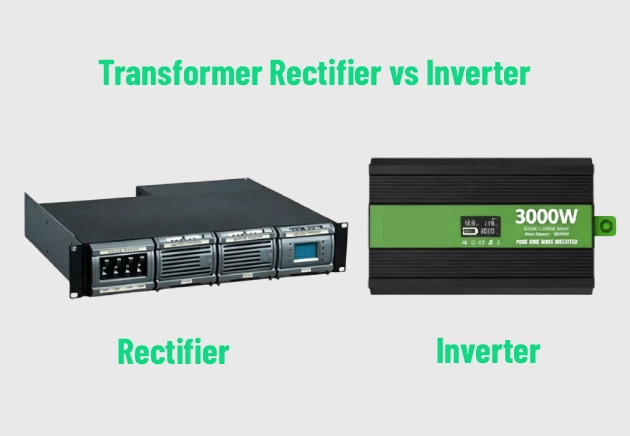
On the contrary, the device that converts direct current into alternating current is called an inverter. In a backup UPS, only the battery needs to be charged, and there is no need to supply power to the load, so there is only one charger. In a dual-conversion UPS, this device not only supplies power to the inverter but also charges the battery, so it is called a rectifier/charger. A rectifier is a rectifying device. Simply put, it is a device that converts alternating current (AC) to direct current (DC).
It has two main functions: one is to convert alternating current (AC) to direct current (DC), and after filtering, supply it to the load or inverter; Secondly, it provides charging voltage for the battery. Therefore, it also serves as a charger at the same time.
An electronic transformer is an electronic device that converts the alternating current voltage of the mains power supply into direct current, and then forms a high-frequency alternating voltage output through semiconductor switch devices, electronic components and high-frequency transformer windings. It is also used in the AC-DC-AC inverter circuits described in electronics.
In simple terms, it mainly consists of a high-frequency transformer core (iron core) and two or more coils. They won’t change their position. From one or more circuits, alternating current is converted into alternating voltage and current through electromagnetic induction. At the output end of the high-frequency transformer, high-frequency AC or DC power supplies of different voltage levels are provided to one or more power circuits.

Posted by Victoria leave words
Thanks for reading! Hope you enjoy this article. If you have any questions about this blog, please leave a comment below, or contact OMEK's online customer service. Looking forward to having in-depth communication with you!
Leave a Reply